
Why Thane Property Prices Rose 46% in 3 Years And What Happens Next?
Introduction
If you’ve been tracking real estate trends in the Mumbai Metropolitan Region (MMR), one thing is impossible to ignore — Thane property prices have surged dramatically in the last three years. A 46% rise isn’t just a number; it reflects a deeper transformation in how people live, work, and invest.
For homebuyers, this raises an important question: Have I missed the opportunity, or is there still growth ahead?
Let’s break down why prices increased so sharply — and more importantly, what the future holds for Thane real estate.
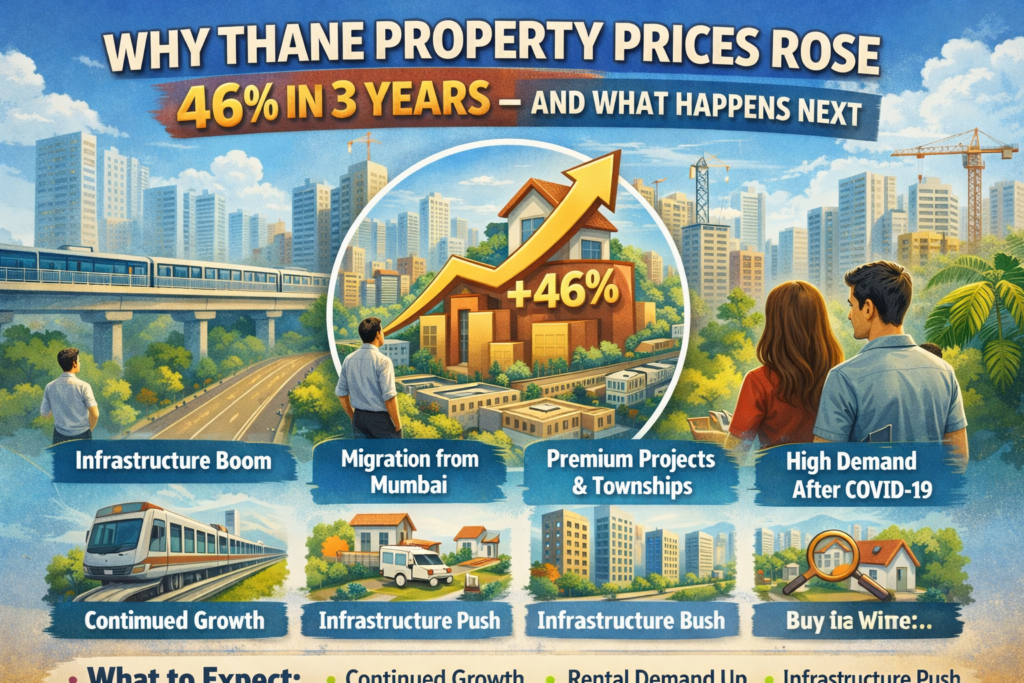
1. Infrastructure Boom Changed Everything
In real estate, “connectivity” is a buzzword, but in Thane, it is a physical reality that has matured rapidly. The 46% price appreciation is directly tied to the “Ready-to-Use” status of massive infrastructure projects.
The Metro Revolution (Lines 4 & 5)
The Metro Line 4 (Wadala–Kasarvadavali) has been the single greatest contributor to capital appreciation along the Ghodbunder Road and LBS Marg corridors. As the viaducts reached 90% completion, property values in adjacent neighborhoods like Kapurbawdi and Majiwada saw immediate jumps.
Equally significant is Metro Line 5 (Thane–Bhiwandi–Kalyan). With Phase 1 expected to become operational by December 2026, the “Orange Line” is opening up the Balkum and Kasarvadavali micro-markets to a whole new demographic of commuters who previously found the central railway line too congested.
The Thane-Borivali Twin Tunnel: The 15-Minute Game Changer
Announced years ago but now seeing significant construction progress in 2026, the Twin Tunnel project is arguably the most anticipated project in the MMR. By cutting travel time between Thane and the Western Suburbs (Borivali) from 90 minutes to just 15 minutes, it has effectively bridged the gap between two of Mumbai’s biggest residential hubs. Investors who bought in 2023-2024 specifically targeted land parcels near the tunnel’s entry points, anticipating the massive “utility jump” the project will provide.
2. The "Corporate Migration" and the Rise of "Thane's BKC"
For decades, Thane was a “dormitory city”—people slept here but worked in South Mumbai or BKC. That dynamic has flipped.
Wagle Estate: The New Commercial Nerve Center
Wagle Estate has undergone a radical transformation from an industrial MIDC zone into a Grade-A Commercial Hub. Often referred to as “Thane’s BKC,” this area is now home to massive IT parks, fintech firms, and multinational corporations.
The Spillover Effect: High-paying jobs in Wagle Estate have created a massive “Walk-to-Work” demand. Professionals working in these corporate parks are no longer looking for budget housing; they are looking for premium 2BHK and 3BHK residences in nearby Vartak Nagar and Panch Pakhadi, driving prices in these areas to record highs.
The Growth of Integrated Townships
Developers like Lodha, Hiranandani, Raymond, and Kalpataru have pivoted from standalone buildings to massive 50–100 acre integrated townships. In 2026, the modern homebuyer isn’t just buying four walls; they are buying an ecosystem that includes schools, hospitals, and retail high-streets within the gates. These “cities within a city” consistently fetch a 15-20% premium over standalone projects, contributing heavily to the city-wide average price rise.
3. Shifting Buyer Sentiment: The "Livability" Index
Post-2022, the definition of a “good home” changed. The 46% rise in prices is also a reflection of a higher “Value-per-Square-Foot” in terms of lifestyle.
Space over Pin Code: Homebuyers realized they could get a luxury 3BHK in Thane for the price of a cramped 1BHK or 2BHK in Mumbai’s western or central suburbs.
Greenery and Air Quality: With the Yeoor Hills and the Thane Creek providing a natural “green lung,” the city offers a quality of life that is increasingly hard to find in the concrete-dense neighborhoods of Mumbai.
The “Lifestyle” Premium: Thane now boasts world-class malls (Viviana, Korum), specialized hospitals (Jupiter, Bethany), and some of the best-ranked international schools in the country. This social infrastructure has made Thane a “destination of choice” rather than a “compromise.”
4. 2026 Outlook: What Happens Next?
If you are looking at the 46% growth and feeling like you “missed the bus,” the data suggests otherwise. While the explosive “catch-up” growth has stabilized, we are now entering the “Steady Appreciation” phase.
Projected Growth for 2026–2028
Market analysts predict a steady 6% to 9% annual appreciation for the next three years. This growth will be driven by:
Operational Metro Lines: Historically, property prices see a final 10-15% “utility jump” the moment the first passenger train runs. For Metro Line 5, that window is December 2026.
Limited Inventory in Prime Pockets: In premium areas like Pokhran Road No. 2, land is becoming scarce. As supply drops and demand for “branded” luxury remains high, prices will naturally stay buoyant.
Rental Yields: Thane is seeing a surge in rental demand. As more companies set up shop in Wagle Estate and Ghodbunder Road, the rental yields (currently around 3-4%) are expected to trend upward, making it a lucrative market for buy-to-let investors.
5. Micro-Market Spotlight: Where to Invest Now?
Not all areas in Thane will grow equally.
High Growth Zones:
- Near metro stations
- Ghodbunder Road
- Kolshet & Balkum
Emerging Areas:
- Kalher
- Kasarvadavali outskirts
- Diva (long-term potential)
Smart buyers should focus on location-specific growth, not just overall Thane trends.
6. RERA Transparency Boosted Trust
The implementation of RERA has been a game changer.
With stricter regulations:
- Project delays reduced
- Builder accountability increased
- Buyer confidence improved
Many buyers who were earlier hesitant now feel safer investing in under-construction projects.
This increased participation in the market contributed to higher demand and rising prices.
Conclusion
The 46% price rise in Thane is not accidental it’s backed by real demand, infrastructure growth, and market maturity.
Thane is no longer just an “affordable alternative” to Mumbai. It has become a destination in itself.
For buyers, the opportunity is still there but the strategy needs to be smarter:
- Choose the right micro-location
- Verify RERA details
- Focus on long-term value